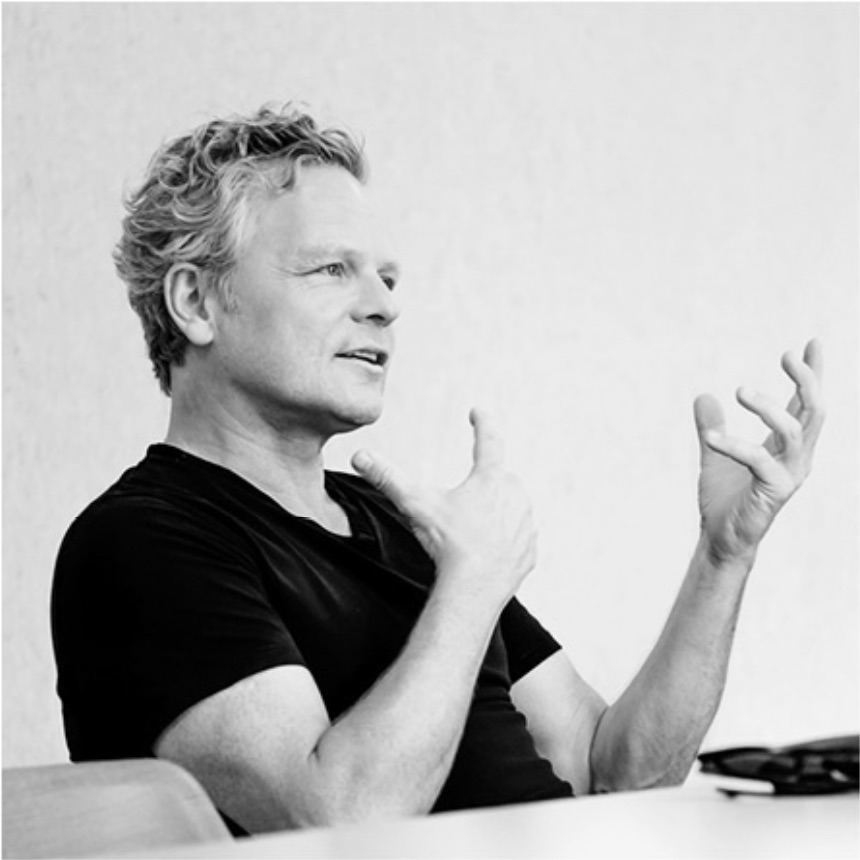
Christoph Felger is an architect, designer and founder of A KIND OF SPACE – Office for Architecture, Research and Design, based in Berlin. After 25 years as Partner and Design Director at David Chip-perfield Architects, he concluded his work there in 2024 in order to reframe architectural practice as a fundamentally collective, interdisciplinary and context-responsive endeavour. This shift is root-ed in the conviction that planning and building are always shared acts and call less for ever-new concepts than for better, more honest and problem-oriented responses, stripped of excess and focused on what is essential, in order to engage responsibly with the pressing questions of our time.
(With A KIND OF SPACE he works across scales and contexts on spatial responses to contemporary ways of living. At the heart of the practice lies a conscious engagement with the existing built fabric, the careful evolution of what is already present, and reuse and transformation as fundamental de-sign strategies. Materials are approached with attentiveness to their origin, their inherent limitations and their inner logic. Local knowledge and craft traditions inform the work as much as an acceptance of imperfection as an integral part of human experience and as a quiet expression of beauty.)
Before studying architecture at the Architectural Association School of Architecture in London, he completed an apprenticeship as a cabinetmaker in the Black Forest and studied product and furni-ture design at Central Saint Martins College of Art and Design in London. He has taught at the Archi-tectural Association, served as an external examiner at London Metropolitan University, and regular-ly contributes as a guest lecturer, critic and competition juror. In addition, he advises municipalities in Germany and abroad on questions of urban development, planning and design and is a member of the design advisory board of the City of Pforzheim in Germany.
During his time at David Chipperfield Architects from 1999 to 2024, Christoph Felger played a key role in establishing the Berlin office and, from there, shaped the development of numerous pro-jects in Germany and internationally. As author and co-author, he was involved in all phases of the design process. These works include, among others, the Nobel Centre in Stockholm, Morland Mixité Capitale in Paris, the Amorepacific Headquarters in Seoul and the extension to Kunsthaus Zürich. His work from this period spans cultural buildings, large-scale transformation projects, work within exist-ing structures, sustainable hybrid buildings and complex urban masterplans. A selection is shown below.